Monday, 30 November 2020

Of aeroplanes and railway trains

 I categorise people into two - are they aeroplanes or railway trains?

Aeroplanes are people who get from point A to point B fast, but by different routes each time. Railway trains are more predictable - they run on set paths, don't deviate too much from set paths, start at the same point and reach their destination by a fixed route in a regulated manner,

Like all categorisations about people, this is not a binary either-or. Every one of us has elements of both but I feel in each of us, one set of traits is more prominent. For instance, being a creature of routine, I am an unabashed railway train. Even after retirement, I get up daily at the same time and my activities fall more or less into the same sequence and same time groove. For instance, I go for a walk in the morning, leaving home at more or less the same time daily and even follow the same route. Needless to say but I walk for thirty five minutes daily, give or take a couple of minutes!

It has its advantages - gives a framework to one's life and an aura of certainty and purpose. People who are aeroplanes don't like to be straitjacketed. They like to try new things, get into new experiences and are perhaps more likely to think differently and maybe even innovate more. Railway trains are more likely to devise systems and procedures and implement them better.

In the context of sales, it is the difference between achieving targets by different methods and  submitting all sales reports in time. In my very first sales job, more than four decades ago, a colleague who was an innovative salesperson was asked by the Big Chief why his reports weren't complete. He replied that the Chief had to decide between getting targets achieved or receiving immaculate reports. Guess what the Boss said - he obviously said he wanted both!

That is not the story of only corporate life. Life in general requires both sets of traits. There are situations which require meticulous execution and others which require total out-of-the-box thinking. All of us are capable of both. It is up to each of us to decide not only what each is more comfortable with, but also to use discretion to decide which approach is more suitable for each situation. 

^^^^


Friday, 24 July 2020

COVID and a Hindi movie trope revisited

One of the most enduring tropes of Hindi films, almost from the time Hindi films started is that of 'lost and found children'.
The typical film using this trope will start with a sweet happy family probably enjoying a picnic or singing a song together. A 'significant' bit of dialogue especially about how happy they are and the experienced viewer knows that this is just a prelude to a tragedy striking the family and that violins will start wailing soon. The cause could be a flood, an earthquake, villains killing the parents, one child being kidnapped or missing a train - the script writer's imagination takes care of the reason. Again, the hard core film buff knows that by the end of the fifteenth reel or maybe the seventeenth, after eight songs, a cabaret dance, sixteen fights, a court scene and a hospital scene or two, everything will end like a fairy tale. In the process of growing up, one of the lost children will invariably be a policeman and another a villain. But the latter is a 'good' villain - he sees the light at the end - as different from the 'bad' villain, who invariably gets pasted or wasted by the hero and the 'good' villain acting in tandem.
O yes, how do the siblings identify each other? It could be a birthmark, an amulet, a tattoo or even just a song which the family sang together in good times - see Yaadon ki Baarat!
Let us now trace how this trope has progressed so far
Version 1.0: in the 1950s mainly - the family gets separated during a mela, preferably the Kumbh mela
Version 2.0: perfected by the film maker Manmohan Desai as part of his winning formula but also used to good effect by Nasir Hussain. The family gets separated when villains kill the parents or are coming to kill them.

Now that this trope has gone slightly out of fashion, it can be revived. Most of us have noticed a strong physical similarity between the President of the United States (POTUS), Mr Donald Trump and the Prime Minister of the United Kingdom, Mr Boris Johnson. This gives me the idea for Version 3.0 - the lost children grow up and head Governments in the USA and UK.
Version 4.0 is even more contemporary and I believe, in the writing. This addresses the most important part of how the brothers recognise each other. One of the brothers contracts COVID 19 (alright, I know one of these two Heads of State did contract COVID - but life should reflect art, shouldn't it?!). Yes, our script looks at one of the brothers being in a serious state and requiring plasma for treatment. Voila, the other brother's plasma reaches and is compatible, leading the doctor in the movie to say 'Tajub hai bilkul 100% match hai - ye dono sage bhai toh nahi hain?'
Please don't look for scientific logic - there isn't any! But you knew it, didn't you ?
***


Sunday, 5 July 2020

Deciphering mama speak - no issues saar!

First things first. Who is a mama?

Accurately speaking, mama is the Tamil word for a maternal uncle, but, usage wise, among Tamil folk it often denotes a male of indeterminate age or indistinct relationship. This way, it becomes a portmanteau word used in many situations especially among the Tamil Brahmin community. This is the word an eighty year old lady can safely use to address a young priest in a temple, for instance. It is amusing that the elderly lady calls a person young enough to be her grandson her uncle, but it is convenient, you see.

A few years back, when I was organising my daughter's marriage, our priest would call me mama, the caterer would call me by the same name and so did the manager of the hall where the functions were to be held. Even the photographer we had hired did likewise. The funny part was that I would also address each of these gentlemen as mama, leaving my daughter wondering as to who indeed was the uncle and who the nephew!

Mamas have perfected the usage of certain catchphrases for certain situations. Those in the know understand the shorthand and answer perfectly. Let us look at just a few of these words.

A mama is looking for a marriage alliance (the word alliance itself is a catchphrase!) for his daughter or has been charged to look for a 'baay' for the daughter of his relative or friend. First thing to be understood is that the prospective groom and bride are always 'baay' and girl, irrespective of age.You can be sure that one of the specifications would be that the boy should have no 'habits'.  No 'habits' is shorthand for no 'bad habits' defined as smoking, drinking or eating non-vegetarian food (Shiva! Shiva!)

Once the baay without habits is identified and other due diligence done, with the blessings of elders, the wedding takes place. After some time, what is certain is that everybody from the next door mami to the milkman will start asking the parents of the boy and girl whether there is any 'good news' i.e. is a little one on the way? The parents are expected to simper or to bluster, by the way.

When the little one is indeed born, mamaspeak calls it an issue. To illustrate, one of the many conversations I have had over the years:

A random mama would ask me, How many issues, saar?
Two, saar
Baays aa?
No saar, both girls
Nowadays, daattars are better than baays wonly, saar.

I hope you understood - else no issues saar!

***


Saturday, 27 June 2020

Let the music flow - a tribute to RDB

Today, one of the most prolific of music directors in Hindi films, Rahul Dev Burman, would have been 81 years old. Unfortunately he died relatively young, more than two decades ago.

Having been the son of the great Sachin Dev Burman, it would have been even more difficult for him to carve his niche. Obviously the long apprenticeship as assistant to his great father helped  R D Burman straddle different genres of songs with ease - rock, folk, classical, quirky. What set him apart was his use of commonplace items of daily use such as broomsticks or combs or even tin sheets to produce beautiful music. Today, social media will be awash with tributes to him and I would like to add my little soupcon.

What I have done is that after visiting a time classification of his work, I have selected films or songs which touched my soul. These are the films (totally ten) selected from each of these periods:

1960s - one: Teesri Manzil
1970s - six: Amar Prem, Aap ki Kasam, Aandhi, Ghar, Manzil. Mehbooba
1980s - two: Masoom, Ijazaat
1990s: one: 1942 - a love story

From each of these films, I have selected the song I like most. I realise that just ten songs out of more than two hundred films is a woefully inadequate sample and that your choices could be drastically different from mine.

Just indulge me, strap on your headphones and listen to these songs:

1. Teesri Manzil - Mohammad Rafi : Deewana mujh sa nahi

https://www.youtube.com/watch?v=-J1PUEiilUU

2. Amar Prem - Lata Mangeshkar: Raina beeti jaaye

https://www.youtube.com/watch?v=RRk9pG5Upe4

3. Aap ki Kasam - Kishore Kumar: Zindagi ke safar me guzar jaate

https://www.youtube.com/watch?v=TqdNqBA44Bg

4. Ghar: - Lata Mangeshkar: Tere bina jiya jaaye na

https://www.youtube.com/watch?v=TqdNqBA44Bg

5. Aandhi - Lata Mangeshkar & Kishore Kumar: Is mod se jaate hain

https://www.youtube.com/watch?v=STOM6NZfcrs

6. Manzil - Kishore Kumar: Rimjhim gire Sawan

https://www.youtube.com/watch?v=HDbi7nP8RV8

7. Mehbooba - Kishore Kumar: Mere naina sawan bhadon

https://www.youtube.com/watch?v=3vPjMX17qC4

8. Masoom - Lata Mangeshkar: Tujhse naraz nahi zindagi

https://www.youtube.com/watch?v=2Q04Z1rCQlk

9. Ijaazat - Asha Bhonsle: Mera kuch saaman tumhare paas

https://www.youtube.com/watch?v=OlvXDGJAMT0

10. 1942 a love story - Kavita Krishnamurthy: Pyar hua chupke se

https://www.youtube.com/watch?v=V0FsE0b7Z-s

Thank you

***


Wednesday, 24 June 2020

Remembering Madan Mohan in Rafi saab's voice - five dimensions of love

This is the fiftieth post on my blog. As a friend on a music group on Facebook mentioned, today is the 96th birth anniversary of one of the the greatest but relatively unsung composers of music in Hindi films - Madan Mohan Kohli, known better as Madan Mohan. This post is a tribute to him.

Some of the best songs tuned by Madan Mohan have been sung by my favourite singer, Mohammed Rafi. Kohli saab's official website https://www.madanmohan.in/ says he composed a tad less than seven hundred songs and in this blog I shall be posting just five of them. I am not going to tell you much about these songs except to fit them into a story of my own. I am not technically competent to tell you about the instruments used or even the ragas in which these songs were composed and will not even try to do that. As a layman and Hindi film buff, at various times, each of these songs has moved me to either sing or whistle alongside or just to say 'Wah ! Wah!' or just to feel myself on a different plane of enjoyment and reverence. I want to share that feeling with you

The five songs which make my story:

1. A young man gets a glimpse of a beautiful woman, feels a terrific attraction and then sings this lovely number from the film Dulhan ek raat ki, 'Ek haseen shaam ko dil mera kho gaya'

https://www.youtube.com/watch?v=H89315fEZTY

2. He meets her, they both fall in love and he is so smitten by her beauty that he breaks into singing
 'Mai nigahen tere chehre se hataun kaise' . Film: Aap ki Parchaiyyan

https://www.youtube.com/watch?v=bHF3sA6B_sA

3. He joins the Army, the stark beauty of the remote landscape reminds him that he is far away from his lady love and .. he sings this lively song from Haqeeqat - 'Masti me chhed ke tarane koi dil ka'

https://www.youtube.com/watch?v=bjHqi5XHMbc

4. The course of love isn't always smooth and he feels he has lost his lady love. He laments thus 'Rang aur noor ki baarat kise pesh karun' from Gazal

https://www.youtube.com/watch?v=CZmSgtSq9T8

5. Fortunately for the hero, it was a false alarm, He does get to marry his heroine and then, this song from Suhagan expresses what he feels 'Tu mere saamne hai, teri zulfein hain khuli .. '

https://www.youtube.com/watch?v=MQ4YKgeZDPA&t=33s


Like most Hindi films and all fairy tales, everyone lived happily ever after !

***


Tuesday, 23 June 2020

Remembering a friend

Friendships formed when one is young often tend to last a long time. Some of these relationships get stronger, some get revived when people meet after a time, some wither away because people drift apart and some are rent asunder by events beyond our control. This blog talks about a friendship which was terminated by one such act - not an act of God but wholly an act of man.

Kumar and I did our Management course together at XLRI, more than forty five years ago. He had the best of both worlds. A married sister of his used to stay within walking distance of the institute's hostel. He stayed with her notionally but spent almost all his waking hours with us at the hostel. His loud boisterous laughter could be heard often, punctuating almost every conversation.

In due  course, we finished our course and joined the corporate world. For a time, both of us were in the same city. We used to meet often, usually at his sprawling family house in central Chennai. He had some health issues, sorted these out and then got married. After some time, we lost contact as I got transferred first and then changed companies and cities. I heard that he and his wife had moved to the States  and he was doing well.

A couple of years later, a chance meeting with another classmate gave me the bad news that he was no more. More details emerged when more of us friends met. Apparently, it happened when he was traveling from the States to India. As he was coming down for a function in the family and couldn't get a direct flight, he went to Canada. With him were his wife, his sister and the sister's three children.

Unfortunately for him that plane was Air India's Boeing 747, Emperor Kanishka flying from Montreal to Bombay on 23 June 1985. More unfortunately, some terrorists had managed to place a bomb in the hold and even more unfortunately, the bomb went off when the plane was over the Atlantic. What was worse was that all the perpetrators were not found and convicted, apparently due to a botched investigation and a turf war involving two Canadian investigating agencies.

Terrorism is just some images on a television screen till it affects somebody close to us. It hit me that day.

What I haven't understood and never will, is what these madmen achieved by placing the bomb in the plane, apart from devastating the lives of almost three hundred families all over the globe - most of whom were not even from the country with which they had a grouse.

I can only tell Kumar 'Keep laughing, wherever you are, my friend'. Om Shanti.

****


Saturday, 6 June 2020

Unlucky number eight

In my family, we haven't ever paid heed to numerology which the dictionary defines as 'the occult significance of numbers', though many people swear by this pseudo-science.

Many decades ago, when we moved house, one of the neighbours in the new place told us that the digits of the house number (116) added to eight which was considered lucky in his part of the country. Looking back, many good things happened in that house, but some many not so good events too. On balance, there was nothing too good or too bad which happened - but that is life, isn't it?

Many years after this, I came across the significance of number eight again but in a diametrically opposite way. I was a sales manager in a company manufacturing motor scooters and while sitting with my dealers in Tamil Nadu, discovered that no customer wanted to purchase a vehicle with the registration number totaling to eight e.g. 1412. The belief was that nobody would buy a vehicle, new or old, with digits adding to eight and hence, the disingenuous excuse that resale of such a vehicle would be difficult. Smart dealers found this to be a route to earn something extra. They persuaded customers that they would have to pay a 'fee' to the clerk at the registration office who assigned numbers to ensure this - and people paid willingly too. If a customer wanted the digits to add up to his lucky number, say 9. the ante went up! The funny part is that customers who would haggle over every extra rupee while negotiating price, would without batting an eyelid pay anything extra demanded for a lucky number or even to ward off an 'unlucky' number.

The ultimate example of such superstition was the customer who threw a tantrum at the time of taking delivery when he found that the total of the digits in the chassis number of his scooter added to eight, though the registration number didn't. He demanded a change in his vehicle which was impossible as the paperwork was already done. The sweet-talking dealer persuaded the customer by telling him that the alternative vehicle was not in the latter's lucky colour!

Just a small example to demonstrate that watching experienced people teaches much more than books can, especially in the areas of sales and customer psychology!

&&&

Wednesday, 29 April 2020

Kitnay aadmi thay ? The complete film

In all my life there is only film I have seen at least fifteen times and wouldn't mind seeing it another fifteen times. Considering that Sholay was released forty five years ago and has become one of Indian film's biggest  money makers ever, that is not surprising at all. Over this period, I have seen this film in Mumbai, I have seen it in Pune, I have seen it in Delhi , I have seen it in Ludhiana, I have seen it on the television, I have seen it on YouTube, I have seen it alone, I have seen it with friends, I have seen it with my wife and again with my wife and daughters.

I was posted to Ludhiana in 1980, just after my marriage. This industrial town in the Punjab was slowly evolving then from being a small town to a large city. One of the traits of a small town it retained was the way films were advertised locally. There would be a man sitting in a tanga, a horse carriage, with a microphone. A couple of men carrying dhols or large drums would walk alongside, beating their drums. When the man in the tanga felt that enough people had been attracted, he would start his sales pitch. It would start with the name of the movie, then move to the names of the stars in it and the next part would be more or less standardised. The standardised part would invariably emphasise action, romance, comedy, tragedy and songs as the main ingredients for all movies with appropriate sound bytes as samples of each to wow the audience.

Let us look at each of these ingredients as they appear in Sholay to try to understand what made it the super blockbuster it was .

* Action: the iconic goods train scene with which the film starts was a good example. It may have been inspired by Westerns but it was very well adapted to the Indian milieu. There is a surfeit of action throughout and in some sequences you suspend belief when you see two small time rowdies tame by themselves a gang of almost a hundred desperadoes led by a psychopath. That's par for the course in Hindi films after all. The confrontation between Sanjeev Kumar and Amjad Khan in the climax is just rivetting in its ferocity

*Romance:  peppered throughout the film are two developing romances -  an open one of Dharmendra with the tangewali Hema Malini and a very underplayed, almost forbidden one of Amitabh Bachchan with Jaya Bhaduri, the widowed daughter-in-law of the Thakur. The former may be in-your-face but the latter, especially the understated acting of both these actors is what stays in the viewers' mind

* Comedy is often used as a tension reducer in stories and there is both comedy and tension in good measure in the film. Be it Jagdeep as the Bhopali wood seller or Asrani as a dim-witted jailer or even Keshto as the jailer's stool pigeon, each leaves his mark. A couple of the main stars too are uproariously funny in their comic sequences. Dharmendra's drunken profession of love from atop a water tank and Amitabh's attempts at singing his friend's praises to Hema Malini's aunt to make her agree to her niece getting married are almost iconic.

*Tragedy: the tragedy at the core of the movie is of course the wiping out of the Thakur (Sanjeev Kumar)'s entire family by the dacoit Gabbar Singh, Jaya Bhaduri's husband is one of the victims and her transformation from a happy-go-lucky village girl to a very young widow having to take care of a handicapped father-in-law is chilling

* Songs are not really important in such an intense story of loss and revenge and this is certainly not one of R D Burman's best scores. The friendship song between Jai and Veeru became quite popular as did the song Mehbooba in a sequence where the arch-villain Gabbar Singh is being entertained. Such was the magic of Sholay that even the two artistes who figure only in this song - Helen and Jalal Agha - are remembered even today .

So what was the magic of Sholay? While each of these ingredients was great , what was the X factor which made this film tick?

Was it the story? A dispassionate look will actually tell you that Bollywood has worked the revenge trope to death. In fact , if you look at an earlier successful film called 'Mera Gaon Mera Desh', many similarities come to the fore - an arm-less central character, a vigilante or two helping a village fight dacoits and even almost identical names for the main villain - Jabbar Singh vs, Gabbar Singh in Sholay. Thus, Sholay's story was actually not pretty original.

Was it the dialogues? The dialogues were quite crisp and punchy. Every time I saw the film in a theatre, I would hear virtually every one join in to say the punch dialogues together. Some of them like 'Arre o Saamba', 'Kitnay aadmi thay?' 'Bahut yaarana hai kya?', 'Tera kya hoga re, Kaliya?' and 'Aao maharathi' have almost become part of folklore. Again, would just hard-hitting speeches be enough to sway audiences? I wonder.

Was it the acting then? Bachchan senior and Dharmendra as the two vigilantes, Sanjeev Kumar as first the brave police officer and then as the handicapped Thakur seeking revenge and Jaya Bhaduri as first the ebullient teenager whom life deals lemons and changes her drastically - were all brilliant. Hema Malini as the village belle did a very decent job as did many of the actors in smaller roles - to name a few, Hangal, Satyen Kappu, Iftekhar, Viju Khote, McMohan, Sachin, Each one of them left his mark. Among so many stalwarts, however, a debutant held his own. He was Amjad Khan who acted as the psychopathic Gabbar Singh. His was easily one of the best debuts ever in Hindi films. None of his roles in later films was so impactful. 

I think the answer to all these questions is like the cooking of a great dish. For that, everything has to be just  so - the right quality of the best ingredients prepared exactly in the right proportions and cooked for the appropriate length of time to the perfect temperature. Sholay had all the components - an engaging story, the right personnel for each role, proper dollops of emotion, action, comedy and tragedy and the entire amalgam turning out just so !

That is why for me, it is the complete film !

***


Friday, 17 April 2020

Taala mai kholunga, Peter

(I thank my friend, Sriram Krishnamoorthy, for giving me the germ of the idea for this blog post, in a conversation we had.)
--

Deewar, the Hindi word for wall brings to my mind two public performers who have given me lots of happiness. One is Rahul Dravid, the noted Indian cricket player who was known as The Wall. Understated to the core as he was, it took fans and critics the end of his illustrious career to understand the depth of his impact on Indian cricket. This blog is not about him though but the other public performer, a film star.

Amitabh Bachhan, the other person who has given me much joy too can be called a Colossus of India's film world. Among his many memorable screen personae was his role as Vijay Verma, the intense brooding gang boss of the 1975 film Deewar. This was the phase he was reinventing himself as an 'angry young man' and carving a big niche for himself. Deewar was released forty five years ago, in 1975 and to me, in this genre of films, has many clones but hardly any equals. Apart from the skill in Yash Chopra's craft as the director and Bachhan's towering performance, the real heroes of the film were its tight screenplay and powerful dialogues - both written by the duo of Salim-Javed. After the success of Deewar, Salim - Javed were virtually the first writers who could command a fat price for their services.

Deewar is the story of how Vijay Verma gets transformed from an innocent child into one of the most notorious gang bosses of Mumbai. Bachhan's smouldering presence almost sets the screen on fire, especially when he renders the fiery dialogue conceived by Salim - Javed. A few pieces of punchy dialogue at crucial junctures of the film not only stay in memory but also act as milestone markers in the main protagonist's hurtle towards a pinnacle before falling as drastically to his doom.
Let me take you along these markers.

1. Mera baap chor hai (my father is a thief)
The film starts with showing the idyllic life of Anand Verma, a trade union leader, his wife and two small boys. Sure enough the peace is shattered. The crooked seth, a Hindi film trope kidnaps Verma's family before a crucial union negotiation and Verma is forced to concede all the gains he has made earlier. Unable to face the wrath of his constituents who feel let down, he just slinks away from home in the dead of night. It is now the turn of his wife and the two boys to bear the brunt of Verma's forced comedown. The climax to this happens when a bunch of drunk workers seize the older boy, Vijay and get 'Mera Baap Chor hai' tattooed on to his forearm. This sears the young child's mind and is the first step to make him a non-conformist and a fighter. This event also forces the family to move to the relative anonymity of bustling Mumbai and eke out their living there.

2. Ye lamba race ka ghoda hai (this is a horse for the long race)
Vijay Verma who is the child with the tattoo on his forearm helps his mother, a construction worker to run the household by shining shoes. Since his younger brother is good at studies, Vijay sacrifices his education to meet the bills. Two goons who go to the races, always get their shoes polished at a stand where Vijay plies his trade. One day one of them throws the coin in payment at the little boy. He asks his customer to respect him and give the money in his hand, saying he doesn't pick up money thrown at him. While the goon demurs and is about to beat the boy, his boss tells him to give the money in the child's hand and tells the assistant in an aside that this boy has staying power - he will go far. You can expect that there will be a link to this 'significant' dialogue when Vijay Verma grows up .. and there sure is!

3. Taala me kholunga, Peter (I'll open the lock, Peter):
By now, Vijay has grown up and has become a dockyard worker. On pay day, a group of goons corner all workers and force them to pay a substantial part of their wages as 'hafta' or protection money. One new boy who protests and refuses is brutally killed to silence any recalcitrant labourers. Something snaps in Vijay's mind and he decides to take the goons on, despite the entreaties of the workers' overseer. Knowing that the goons are looking for him, Vijay waits for them in a warehouse and when they rush to lock the door to stop him from going out, he in turn locks it before them, takes the key, puts it in the pocket of Peter, the head of this small group of rowdies and tells him that the door will be opened only by him after taking the key from Peter, meaning after he beats the goons up. In true filmi style, an unarmed Vijay single-handedly beats up seven or eight tough, armed goons, takes the key out of Peter's pocket and comes out to the applause of the suppressed workers. This gets him the attention of a master goon, Dawar, who surprise surprise is the person who predicted earlier that Vijay is one for the long race. Peter's boss is Samant, who is Dawar's biggest rival in crime. Dawar now takes Vijay into his gang and sure enough, the first payment is thrown across a table. As expected, Vijay reminds him of his visits to the races and asks Dawar to give the money respectfully.

4.Mere paas ma hai ( I have our mother with me)
Vijay joins Dawar's gang and has many skirmishes with Samant. He invariably wins, because of his street smartness and some luck. He becomes very rich and moves the family to a much bigger house. In the meantime, the younger brother, Ravi, completes his studies and joins the Police. The first case file handed to him is that of apprehending a big gang of smugglers. When he goes through the file, he is shocked to see Vijay's photo staring at him. He and his mother move out to their old house and this shakes Vijay. Both the brothers meet near a deserted bridge in one of the memorable scenes from the film. During the confrontation, Vijay tells Ravi that he has all the comforts money can buy which the police uniform cannot even attain in its dreams. Ravi retorts that he has their mother with him, an iconic punch line of the film. He then entreats Vijay to surrender to the police. The title refers to the Deewar or wall between the brothers.

5. I am falling in love with a stranger
These are the opening words of a song played softly in the background in a high-end bar when Cupid strikes Vijay. (Ravi is already attached to his class mate, the Police Commissioner's daughter). Vijay meets Anita at the bar, they decide to get married and he seriously contemplates turning himself in to the law. While looking for Vijay, Samant and his men barge into his house when he is not there and kill the hapless Anita. In rage, Vijay chases Samant to his lair and literally throws him out of the window. This intensifies the gang war and the police also enter the fray

6. A long conversation with God at a temple
One day, Vijay finds himself being chased by the police. While trying to escape, his talisman falls out of his pocket and his brother's bullet grazes him. He manages to get to his car and during the chase, gets seriously injured when the car hits a wall. By coincidence, it is the wall of the temple where he would take his mother daily but not go inside. He realises he is dying and has a conversation with the deity talking about all the injustice done to him and trying to justify what he did. His mother reaches the temple during this diatribe and he just about manages to fall in her lap and die.

Hopefully these milestone dialogues help you to remember the film if you have already seen and if you haven't seen it, give you a framework to follow the movie.

In postscript, that year, Deewar swept the Filmfare awards,  winning in six categories of the nine for it which it received nominations. The irony here was Bachhan as Vijay Verma did not win - he was pipped at the post by an equally consummate actor, Sanjeev Kumar for the latter's role in Aandhi. To add to the irony. Shashi Kapoor got the award for Best Supporting Actor at the Filmfares.

Forty five years later, when I look back at Deewar, I see many of the cliches and standard tropes of Hindi films, especially of those from that era. What made the film memorable was Yash Chopra's craft, the taut story and screenplay and punchy dialogue with the pair of Salim - Javed being responsible for all the three. Amitabh Bachhan's delivery of the dialogue and his portrayal of the angst of the little hurt boy transforming into rage at society is what remains in the mind of the viewer, especially this one.


&&&


Sunday, 12 April 2020

What were you doing when India won the cricket World Cup?

For Indian cricket aficionados of my vintage, the cricket World Cup victory refers only to 1983. India has won two more World Cups subsequently - the first T 20 World Cup in 2007 and the ODI World Cup in 2011. Foe me, neither has created the same impact as the 1983 victory did. The 1983 win is also more vivid for what I was doing that day.

At the time I started following cricket, Test cricket was the only form of international cricket - leave alone T 20s, even ODIs started only a decade or so later. Indian players would probably play a maximum of two series a year, one at home and one abroad and often lose both. Newspaper coverage was extensive even of Ranji Trophy matches. I distinctly remember, as a small child, spreading the newspaper on the dining table and poring over the sports page while sitting on my haunches on the chair. Radio coverage was also available for all international matches.

In the midst of all this, a major innovation took place - One Day Internationals. The first World Cup of ODIs happened in 1975. India's performance in both 1975 and 1979 was nothing much to write about and the 1983 World Cup happened in this backdrop. Even Indian fans did not give their team much of a chance at the start of the tournament though the team was decidedly much better than before. In the league stage, captain Kapil Dev's epic 175* against Zimbabwe was virtually the difference between yet another early exit and a tilt at glory. Came the final on Saturday 25th June. Looking at the stalwarts in the West Indian team - the openers Haynes & Greenidge, the great Viv Richards, the captain Clive Lloyd, the awesome quartet of fast bowlers Roberts, Holding, Marshall and Garner - Indian fans and the Press had virtually resigned themselves to being runners-up.

The company I was working in then - Kinetic Engineering, Pune - very conveniently sent me to Mumbai on the day of the Final, a Saturday to meet some of our important vendors and chase them for components required for a model of a moped under development.

I left home before 6 am and reached Mumbai at around 10, being dropped by the company vehicle in the central locality of Dadar, I wended my way to a manufacturer of shock absorbers at the faraway suburb of Bhandup after meeting a couple of vendors en route. I just about managed to meet my contact, the avuncular Mr Jayaraman before he left for home to watch the match on TV, collected some samples which were ready and prepared to go across the length of Mumbai to book these by road to our works. I was accompanied by Irfan, his colleague  who kept cursing me good-naturedly because I was preventing him from seeing the match. By the time we finished our work and went back by train, he to his house and I to my next port of call, both in the same direction, we found that the Indian innings had ended and at only 183 runs, which only got me more friendly abuse from Irfan!

My next meeting was at an industrial estate in the western suburb of Andheri with a company manufacturing locks. I reached the factory and found the shutters down. Talked to the person in the next office who was also closing shop and got a pitying look from him for working when the World Cup final was on! Fortunately, he not only was a friend of the lock manufacturer, Anant, he also knew where he lived. Trudged again to the nearest railway station, traveled by the suburban train back to Dadar where Anant lived. Located his house, he fortunately had the samples I needed ready and he invited me to watch the match on his TV set. I did do so for a short time to see Greenidge losing his stump to Sandhu! West Indies 5 for 1, which gave a small sliver of hope.

I then booked my return ticket to Pune by the Government ST bus from the Dadar bus stand and went to a nearby restaurant for a quick bite. While I was having my dinner, found that West Indies had reached 50 for no further loss which only made me feel more tired (I had been on my feet virtually from 6 am and it was now about 9 pm). Suddenly, in quick succession , we heard bursts of crackers four times - West Indies had suffered a meltdown and had slumped to 66 for 5 with both Richards and Lloyd back in the hutch. Indian hopes slowly rising.

I boarded the bus and was very happy to see a Sardar co-passenger glued to his transistor. Glory be! We could keep track of the score on the way. The ST bus even stopped in the city to enable him put fresh batteries in his set. Soon Faoud Bachus got out, the last of the recognised batsmen, WI 76 for 6 and Indian fans dreaming big. But Dujon, the wicket keeper and Marshall the fast bowler dug in and kept scoring slowly but steadily. The total moved from 80 to 90, 90 to 100 , to 110, 115 and now Indian fans were certainly skittish! Mohinder Amarnath worked his magic and bowled Dujon and soon had Marshall too. WI 124 for 8. India almost had their hands on the cup, especially when Kapil Dev got Andy Roberts soon, trapped in front of the wickets WI 126 for 9. Just one wicket for India to cause a stupendous upset. We did not bother about the 57 runs which their last wicket needed!

All this while, we did not take any notice of where the bus had reached. Each time a  West Indian wicket fell, the Sikh would break into a bhangra - on the moving bus, mind you - and most of the other passengers would join in. We noticed the bus stopping and were a bit surprised to see that we had reached the half way stop of Lonavala. Surprisingly and considerately, the time keeper at the bus stand relayed the radio commentary over the PA system. Indian nerves started getting frazzled again as the last pair of Garner and Holding held fort. They didn't score much but weren't getting out either. A screech over the PA system rent the air finally - Amarnath had trapped Holding lbw and West Indies had collapsed to 140 all out, leaving India World Cup champions for the first time.

My enduring memory of that final ball is of a 65 year old man leap into the air and let out a blood-curdling scream. The sweet shop at the Lonavala bus stand never had it so good. An avalanche of customers from the buses waiting there descended on the shop and in a jiffy, bought all their wares. Total strangers were offering sweets to each other while dancing and shouting - all this at 11.30 in the night. Even I did so! The rest of the journey was almost an an anti-climax and quite frankly, I don't remember much of it now.

I did see on television every ball of India's subsequent World Cup victories and was thrilled to see Mahendra Singh Dhoni lift the cup both at Johannesburg in 2007 and Mumbai in 2011. But for me, the drama in these victories was just not there - despite the fact that the opponent in 2007 was Pakistan and that it was a much closer match.

Maybe the earliest victory has stayed in my mind because of the physically tiring work I put in that day- about three hundred kilometers is the round trip distance between Pune and Mumbai and comfortably another hundred at least  I would have covered that day within Mumbai by train, taxi and auto-rickshaw. Being on one's feet for eighteen hours at a stretch and travelling about four hundred kilometers while doing work is not for the faint-hearted, but I was only thirty then and India did win, didn't it !

Hope you enjoyed this account ! If nothing else, for me it refreshed thirty seven year old memories !

***


Tuesday, 7 April 2020

Guide - the film and its story through its music

In a lifetime, even if one is not an inveterate moviegoer, one ends watching perhaps hundreds of films. Of these films, I don't even remember the names of some today, others I may have enjoyed then but may find boring now, yet of others I would recall many scenes but these would not have really changed my life much. At the very top of my list are just about a handful of movies which have seeped into my consciousness and stayed there. In this elite lot is the 1965 Hindi film Guide, based on R K Narayan's eponymous novel. After the film was completed, R K Narayan dissociated himself from this project as he had major differences with the way a couple of seminal relationships were depicted, but that is not germane to this blog post.

I have also had a love affair with music of different genres for almost six decades with Hindi film music occupying the stellar position. Maybe my choice of film music is stuck in a time warp of the sixties and seventies - maybe, but I am of late trying to make myself au courant with film music of later years also. In my pantheon of music director stars, there are many notable composers - Shanker-Jaikishen, R D Burman, O P Nayyar, Laxmikant Pyarelal, Roshan, Madan Mohan, Naushad , to just name a few - but the numero uno composer for me has always been Sachin Dev Burman, the scion of the royal family of Tripura. Again, I could reel off, at any time, the names of at least fifteen films with S D Burman's mellifluous music but here again for me Guide is my first choice. I have read elsewhere that he himself considered this film to be his best and was sorely disappointed at it not getting any major awards. I think the very fact that we talk about its music and hum its songs even fifty five years after it made its debut is the best award  Sachinda could have got.

The best part of the music and songs of Guide, for me was that none of the songs was an add-on or a diversion from the main plot. Each song was integral to the story, blended perfectly with what happened before and after and helped to move the narrative along. This is due to the craft of both the film maker and the music director and the tremendous synergy between the two of them.

Let me now try to tell you the story of Guide through its songs. This sequence is not necessarily that in which the songs appeared in the film

*The film opens with 'Wahan Kaun hai tera'. As the credits roll, we see Raju the guide being released from jail and being undecided on his next step. Sachin Dev Burman's mocking tone and the almost haunting deep notes of the flute rub in Raju's dilemma clearly.

* Rosie, the dancer and progeny of a courtesan has had to sacrifice her love for dancing for respectability. When she gets an opportunity to dance, the flood of emotions breaks through the dam of her restraint and she breaks forth with lyricist Shailendra's apparent contradiction 'Aaj phir jeene ki tamanna hai, aaj phir marne ka irada hai'. The words are poignant and ironic at the same time as this is a short while after she has attempted suicide, in the film.

*Rosie and Raju spend a lot of time with each other and the almost inevitable happens. Raju falls in love with her and expresses his feelings with, what is to me, the most romantic love song filmed ever! The song .. Rafi's 'Tere Mere sapne ab ek rang hain' of course.

*Rosie takes time to reciprocate and she does do so later. singing along with Raju the ebullient, bouncy  'Gata rahe mera dil' . To convey this joie de vivre , the composer has used Kishore Kumar with Lata Mangeshkar here. Rosie and Raju now defy society, burn some bridges and set forth together as a joint venture.

*Rosie's career as a dancer is launched with the screen name of Nalini and the lovely Lata Mangeshkar number 'Piya tose naina laage re' shows her transition from a virtual nonentity to a star dancer, The device of showing different festivals in the song transports the story further.

* The beautifully soft, maudlin Rafi number 'Din dhal jaaye' shows Raju slowly taking to both drinking and gambling and also the widening of the crack in the relationship between Raju and Rosie.

*The next dance number 'Mose chhal kiye jaa' which is followed immediately by another Rafi hit 'Kya se kya ho gaya' jointly present the story of a crime and a betrayal, as at the end of the second song, a handcuffed Raju is seen being taken away. Raju forged Rosie's signature (and got caught) not only because he wanted Rosie's jewels but because he didn't want Marco, her estranged husband to meet her and take her away from him. He is not able to explain this to her, either, because by then their relationship has soured quite a bit.

* The other two songs in the films - 'Allah Megh De' and 'He Ram Hamare Ramchandra' are sung by the residents of the drought-hit village to which Raju stumbles when running away from the world on his release from jail. He reluctantly becomes a Swami and is dared into fasting for rains to save  the village. The film ends with the rains falling and the villagers celebrating. The camera then pans to a supine Raju, who has passed away.

This is my bit of the intertwining of the story line and the songs to explain the plot. I would love to hear from you what you think of this bit of story weaving from my end!

^^^^^^


Friday, 3 April 2020

Of dhotis and lungis

One point of amusement or irritation to a South Indian, depending on his mood, is when his friend from across the Vindhyas calls his dhoti a lungi. What is worse, the latter often doesn't even realise why the former is getting miffed with this description.

Maybe this will help .. or maybe not ! A dhoti is a dhoti is a dhoti .. right? Well ... no.


I first started wearing LUNGIS at home when I was about 16 or so - bright colours, vivid designs. Remember particularly one with red swirls on a yellow background !


On formal occasions - marriages in the family, temple visits - I still wear a white two-layered MUNDU (Malayalam)  or a VESHTI (Tamil), often having a thin zari border. This is wrapped around the waist and sometimes accompanied with a small cloth called an angavastram draped across one shoulder.


For very formal or religious occasions - the wedding of my daughters or my parents' shraaddham - I wear it PANCHAKACHAM style - similar to the way a dhoti is worn on formal occasions in the rest of India.


From lungis, I moved on to KAILEES - usually checks of one colour on a different background, often white.

Now at home I wear what in Kerala is called a KAAVI MUNDU - similar to a white one in that it is wrapped around the waist but usually single layer and in a variety of colours. Kaavi is the word for saffron - these started as different shades of saffron, but are now available in many colours. I have even a light blue one !


Next time somebody calls my mundu a lungi, I'll compliment him on the dupatta he wears with his churidar - kameez !

Thursday, 16 January 2020

Time managers and damagers

In a long career of more than four decades, I had many bosses and peculiarly in one organisation itself, two bosses at the extreme ends of the spectrum of time management - one excellent manager of time followed by a master 'damager'.

The late Mr P was the master of managing his time. He had chalked out in his mind before he came to work exactly what he'd be doing that day and stick to the plan almost perfectly. Exactly at 9 am, one would see the security personnel at the door straighten up because Mr P had entered. A small bird-like man would walk in briskly, followed by his driver carrying his briefcase. There would then be a sequence of activities and meetings exactly as per schedule. He had built in enough cushioning into his plan though to allow for any emergencies or drop-in visitors. It was always a pleasure to attend meetings with him. The agenda would be circulated in advance and at the start itself, he would announce how much time would be devoted for each item. If the discussion on a point was going too long, he would announce that he would give a couple of more minutes for all to reach consensus, else he would take a decision. This was enough to bring things back on track.

The Gods who watched over that company obviously did not like all this. The group of which this organisation was part went through a restructuring recommended by one of the Big Four consultants in which this company became a division of another group company, Mr P was kicked upstairs and we had a new boss, Mr A. It would suffice to say that this gentleman would never be available at the time he had allocated to somebody. As one of my colleagues put it searingly "Busy? Yes, if you call waiting in my boss's ante-room for two hours for him to call me being busy, I was very busy!". Not only would the new top man not manage his time properly, he also ensured that he managed to mess up the working days of most of those reporting to him. No wonder then that this company which was running very well before he took over was first sold to its competitor about five years down the line and then closed down. I did not wait that long, though - I left almost immediately after Mr A came into the picture, for totally different reasons.

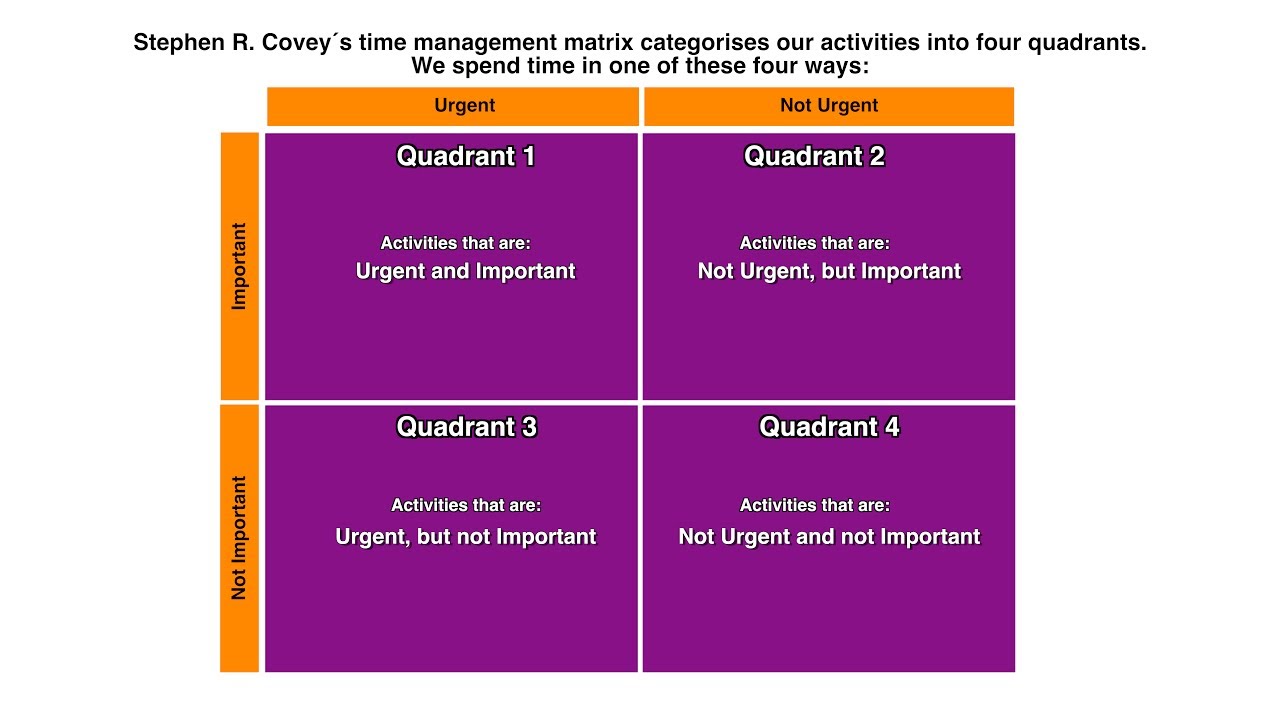
Time management is one of the basic skills needed for working in an organisation, but sadly one of those given least importance. A basic framework such as Stephen Covey's grid (below) is a very good starting point, as long as the self-classification is done honestly. In many sessions conducted by me for working executives, when I have asked them to do this exercise, I have almost always come across a proportion of 40 % for activities in Quadrant 4. This is a huge eye-opener and spurs a better understanding of how time is spent badly.

Image result for stephen covey's time management matrix
Apart from day-to-day operations, an important area where time management goes for a toss often is the organisation of 'functions'. Very rarely do these start on time and even more important, end on time. More often than not, things go out of kilter because at least one of the speakers exceeds the time allocated to him. Just today, I read a report of a meeting where one of the doyens of India's IT industry was the main speaker. Miffed at the entire function starting an hour late, he condensed his scheduled twenty five minute speech into five minutes and left the stage in a huff, after announcing why he was upset. I fully empathise with him!

Especially when such functions are organised in academic institutions, the organisers should ensure that professors, especially retired ones be handed the microphone only with trepidation! In one of the organisations I was associated with, we had a senior worthy who was notorious for rambling almost interminably. We wrote his speech for a conference inauguration and despite this, kept a ten minute cushion knowing this tendency of his - he still knocked our schedule for a six by speaking extempore for another ten. The delicious irony of course was that a colleague of mine and I had to listen to a twenty minute exposition of the need for brevity in speech when we went to invite him for this inauguration!

I have always wondered why people find this simple skill so difficult. Now that I have more or less done with teaching, I can bravely say that I was never ever late for any of the hundreds of classes I handled in these two decades - all it required was a bit of planning and more important, a sense of consideration for the other person's time. As one wizened friend used to tell me often, he never had any respect for those who did not respect another person's time (and money). People who are tardy often do not have respect for the other person's time and money, be the other person a family member, a friend, an associate or a client. Does this emanate from sheer lack of organisation or an inflated sense of one's own importance or a total disregard for others ?

I wonder ...


***