In a long career of more than four decades, I had many bosses and peculiarly in one organisation itself, two bosses at the extreme ends of the spectrum of time management - one excellent manager of time followed by a master 'damager'.
The late Mr P was the master of managing his time. He had chalked out in his mind before he came to work exactly what he'd be doing that day and stick to the plan almost perfectly. Exactly at 9 am, one would see the security personnel at the door straighten up because Mr P had entered. A small bird-like man would walk in briskly, followed by his driver carrying his briefcase. There would then be a sequence of activities and meetings exactly as per schedule. He had built in enough cushioning into his plan though to allow for any emergencies or drop-in visitors. It was always a pleasure to attend meetings with him. The agenda would be circulated in advance and at the start itself, he would announce how much time would be devoted for each item. If the discussion on a point was going too long, he would announce that he would give a couple of more minutes for all to reach consensus, else he would take a decision. This was enough to bring things back on track.
The Gods who watched over that company obviously did not like all this. The group of which this organisation was part went through a restructuring recommended by one of the Big Four consultants in which this company became a division of another group company, Mr P was kicked upstairs and we had a new boss, Mr A. It would suffice to say that this gentleman would never be available at the time he had allocated to somebody. As one of my colleagues put it searingly "Busy? Yes, if you call waiting in my boss's ante-room for two hours for him to call me being busy, I was very busy!". Not only would the new top man not manage his time properly, he also ensured that he managed to mess up the working days of most of those reporting to him. No wonder then that this company which was running very well before he took over was first sold to its competitor about five years down the line and then closed down. I did not wait that long, though - I left almost immediately after Mr A came into the picture, for totally different reasons.
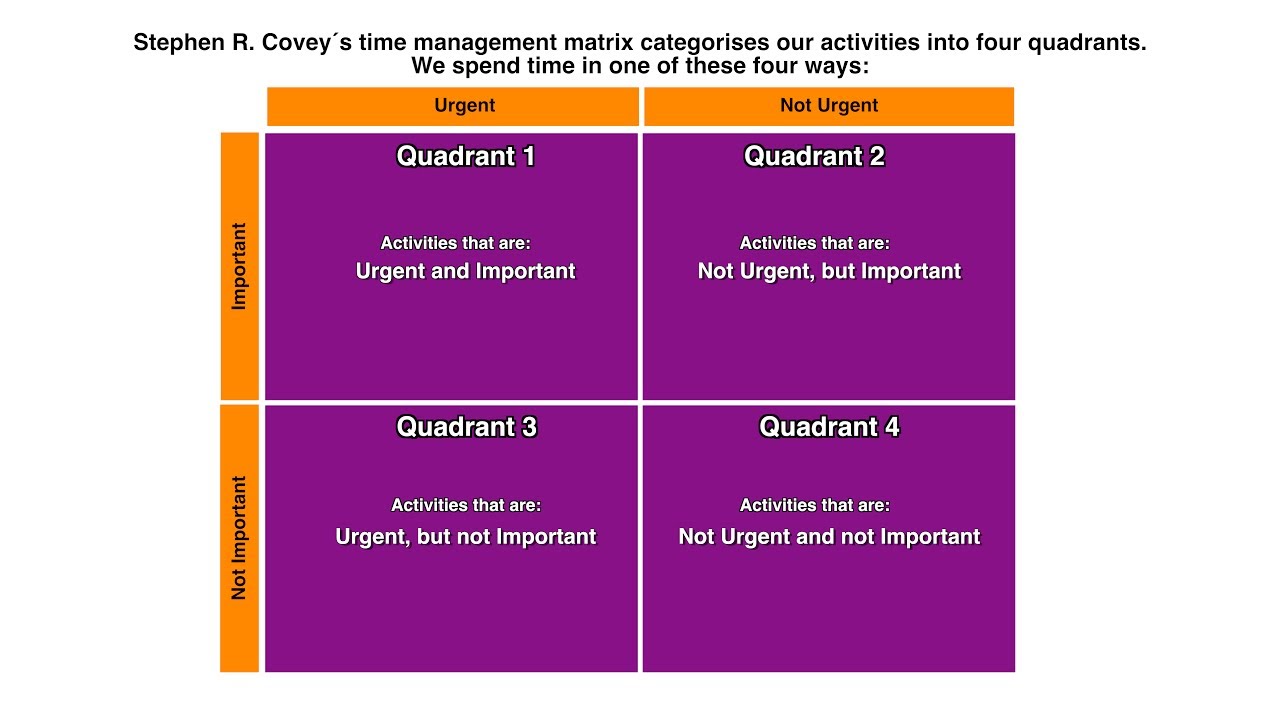
Time management is one of the basic skills needed for working in an organisation, but sadly one of those given least importance. A basic framework such as Stephen Covey's grid (below) is a very good starting point, as long as the self-classification is done honestly. In many sessions conducted by me for working executives, when I have asked them to do this exercise, I have almost always come across a proportion of 40 % for activities in Quadrant 4. This is a huge eye-opener and spurs a better understanding of how time is spent badly.
Apart from day-to-day operations, an important area where time management goes for a toss often is the organisation of 'functions'. Very rarely do these start on time and even more important, end on time. More often than not, things go out of kilter because at least one of the speakers exceeds the time allocated to him. Just today, I read a report of a meeting where one of the doyens of India's IT industry was the main speaker. Miffed at the entire function starting an hour late, he condensed his scheduled twenty five minute speech into five minutes and left the stage in a huff, after announcing why he was upset. I fully empathise with him!
Especially when such functions are organised in academic institutions, the organisers should ensure that professors, especially retired ones be handed the microphone only with trepidation! In one of the organisations I was associated with, we had a senior worthy who was notorious for rambling almost interminably. We wrote his speech for a conference inauguration and despite this, kept a ten minute cushion knowing this tendency of his - he still knocked our schedule for a six by speaking extempore for another ten. The delicious irony of course was that a colleague of mine and I had to listen to a twenty minute exposition of the need for brevity in speech when we went to invite him for this inauguration!
I have always wondered why people find this simple skill so difficult. Now that I have more or less done with teaching, I can bravely say that I was never ever late for any of the hundreds of classes I handled in these two decades - all it required was a bit of planning and more important, a sense of consideration for the other person's time. As one wizened friend used to tell me often, he never had any respect for those who did not respect another person's time (and money). People who are tardy often do not have respect for the other person's time and money, be the other person a family member, a friend, an associate or a client. Does this emanate from sheer lack of organisation or an inflated sense of one's own importance or a total disregard for others ?
I wonder ...
The late Mr P was the master of managing his time. He had chalked out in his mind before he came to work exactly what he'd be doing that day and stick to the plan almost perfectly. Exactly at 9 am, one would see the security personnel at the door straighten up because Mr P had entered. A small bird-like man would walk in briskly, followed by his driver carrying his briefcase. There would then be a sequence of activities and meetings exactly as per schedule. He had built in enough cushioning into his plan though to allow for any emergencies or drop-in visitors. It was always a pleasure to attend meetings with him. The agenda would be circulated in advance and at the start itself, he would announce how much time would be devoted for each item. If the discussion on a point was going too long, he would announce that he would give a couple of more minutes for all to reach consensus, else he would take a decision. This was enough to bring things back on track.
The Gods who watched over that company obviously did not like all this. The group of which this organisation was part went through a restructuring recommended by one of the Big Four consultants in which this company became a division of another group company, Mr P was kicked upstairs and we had a new boss, Mr A. It would suffice to say that this gentleman would never be available at the time he had allocated to somebody. As one of my colleagues put it searingly "Busy? Yes, if you call waiting in my boss's ante-room for two hours for him to call me being busy, I was very busy!". Not only would the new top man not manage his time properly, he also ensured that he managed to mess up the working days of most of those reporting to him. No wonder then that this company which was running very well before he took over was first sold to its competitor about five years down the line and then closed down. I did not wait that long, though - I left almost immediately after Mr A came into the picture, for totally different reasons.
Time management is one of the basic skills needed for working in an organisation, but sadly one of those given least importance. A basic framework such as Stephen Covey's grid (below) is a very good starting point, as long as the self-classification is done honestly. In many sessions conducted by me for working executives, when I have asked them to do this exercise, I have almost always come across a proportion of 40 % for activities in Quadrant 4. This is a huge eye-opener and spurs a better understanding of how time is spent badly.
Apart from day-to-day operations, an important area where time management goes for a toss often is the organisation of 'functions'. Very rarely do these start on time and even more important, end on time. More often than not, things go out of kilter because at least one of the speakers exceeds the time allocated to him. Just today, I read a report of a meeting where one of the doyens of India's IT industry was the main speaker. Miffed at the entire function starting an hour late, he condensed his scheduled twenty five minute speech into five minutes and left the stage in a huff, after announcing why he was upset. I fully empathise with him!
Especially when such functions are organised in academic institutions, the organisers should ensure that professors, especially retired ones be handed the microphone only with trepidation! In one of the organisations I was associated with, we had a senior worthy who was notorious for rambling almost interminably. We wrote his speech for a conference inauguration and despite this, kept a ten minute cushion knowing this tendency of his - he still knocked our schedule for a six by speaking extempore for another ten. The delicious irony of course was that a colleague of mine and I had to listen to a twenty minute exposition of the need for brevity in speech when we went to invite him for this inauguration!
I have always wondered why people find this simple skill so difficult. Now that I have more or less done with teaching, I can bravely say that I was never ever late for any of the hundreds of classes I handled in these two decades - all it required was a bit of planning and more important, a sense of consideration for the other person's time. As one wizened friend used to tell me often, he never had any respect for those who did not respect another person's time (and money). People who are tardy often do not have respect for the other person's time and money, be the other person a family member, a friend, an associate or a client. Does this emanate from sheer lack of organisation or an inflated sense of one's own importance or a total disregard for others ?
I wonder ...
***
